
Showing posts with label 1918. Show all posts
Showing posts with label 1918. Show all posts
Sunday, April 22, 2012
Gunboat USS Carl Schurz ~ 21 June 1918

Saturday, April 21, 2012
Diamond Shoal Lightship (LV-71) ~ 6 August 1918
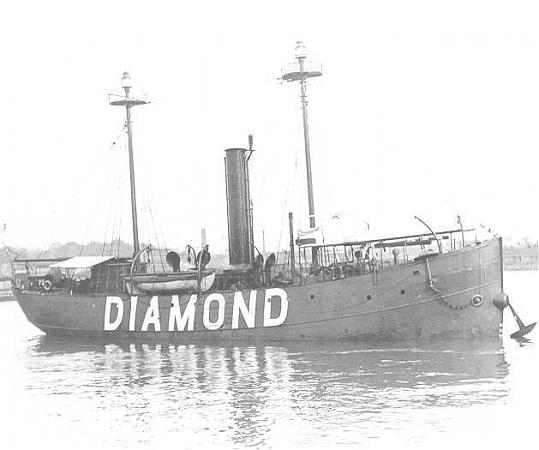
The LV-71 was built in Bath, ME in 1897 for the U.S. Lighthouse Service and for 20 years served as a floating lighthouse and aid to navigation in the waters of the Mid-Atlantic Coast. The majority of her service life was spent marking the treacherous waters off Diamond Shoals.
Commanding Officers
1898: August B. Blom, Master (Mar-Nov)
1907-?: George Selson, Mate
?-1913: William L. Montague, Mate
1913: John M. Kendle, Mate
1913: A.T. Loss, Mate
1913-1915: C.H. Pertner, Mate
1914: Ole Axdal, Mate
1915-1916: A.M. Thistel, Master
1914-1917: Thomas Simmons, Mate
1917: Frederick J. Pusey, Mate
1917: William Harvey, Master
1917-1918: Edwin E. Holm, Mate
1918: Walter L. Barnett, 1st Mate
Construction Modifications & Historical Notes
- 14 Feb 1898: Delivered to Edgemoor Depot, DE. Although built for Overfalls Shoal, LV-69 on Diamond Shoals needed repair so LV-71 was placed there 9 Mar, then alternated with LV-69.
- 7 Oct 1899: Replaced LV-69 which had blown ashore 18 Aug; station apparently vacant from 18 Aug to 7 Oct.
- 1900: Dragged off station in heavy weather 9 times during the year; regained station unassisted on each occasion.
- May 1900-22 Jun 1901: Temporary duty on Tail of Horseshoe until LV-45 arrived; showed oil lights while on this station; steel stem, keel, bilge and sheer strakes reinforced with diagonal steel braces keel to sheer; wood planked keel to main deck level; steel plated from main deck level to weather deck.
- Jan 1904: Supplied with wireless telegraph equipment by Navy Dept.
- 1904: Fitted with special submersible mooring buoy.
- 1905: Equipped with 18" searchlight maintained in southeasterly direction at 45 degrees to horizon while on Diamond Shoal station.
- 1905: While on Diamond station, showed searchlight with beam kept southeasterly at 45 degrees to horizon "to provide earlier warning than masthead lights".
- 1906: Cluster lights replaced with single 375mm electric lens lantern at each masthead.
- 1908: Converted to electric arc lights.
- 1910: Converted back to electric incandescent.
- 1910: Submarine bell signal installed.
- 1912: Equipped with radio provided by USLHS.
- 9 Jan 1912: Rammed by schooner John Bossert; considerable damage to starboard hull plating and to engine room machinery.
- 1915: Dragged off station during severe coastal storm; regained station on 14 Jan.
- 24 Apr 1915: Took aboard the Master, his wife and 10 crew from wrecked 5-masted schooner M.D. Cressy; provided food and clothing and transferred to passing vessel.
- Jul 1917: Arrangements made with the U.S. Navy and Weather Bureau to provision LV-71 with meteorological equipment so that she could record and report weather observations which she did twice daily by radio.
With the U.S. at war with Germany and her allies in WWI, the waters off the Carolinas were infested with U-boats attacking allied merchant shipping. The LV-71 maintained her vulnerable station during the war and was required to be unarmed, such was the importance of her role guiding ships past the shoals, where she found herself the night of August 5, 1918.
After a nearby merchant ship was torpedoed early that evening, the LV-71 rescued the survivors and transmitted a radio warning to other ships in the area. Possibly either the The message was intercepted by the submarine U-104, and after giving the crew opportunity to abandon ship in the boats, LV-71 was sunk by surface gunfire.
The Merak or Stanley M. Seaman which were lost off Cape Hatteras at about the same time.
According to the document German Submarine Activities on the Atlantic Coast of the US and Canada (Office of Naval Records & Library), 8 U-boats operated off the U.S. coast during WWI: U-53 in 1916 and 7 others in 1918.
Many American sailors on sunk vessels were captured and taken aboard U-boats for days or weeks. Their eyewitness accounts of U-boat operations and living conditions make for interesting reading. Raiders of the Deep by Lowell Thomas includes interviews with WWI U-boat skippers with a big section devoted to operations off the U.S. east coast in 1918.
Friday, April 20, 2012

Tuesday, March 13, 2012
Schooner Luna ~ 29 July 1918
At 6:30 a.m. July 29 Keeper Mitchell Hamilton of the Portsmouth Station called Keeper David Williams of the Ocracoke Station for assistance with a schooner on the beach 5 miles SSW. The vessel proved to be the three-masted schooner Luna, en route from Savannah, GA to New York City. Captain F.A. Allen had made an error in navigation to his chronometer being out of order. Wrote Williams:
W. Roberts, No. 1 surfman, on south patrol ... discovered three mast schooner ashore ... Arrived ... opposite the wreck at 7:00 a.m. and placed gear in proper position. The first shot was unsuccessful The second shot was a true hit. The Coast Guard crew of station No. 187 arrived this time and both crews were busily engaged until 9:15 a.m. when crew of five men were safely landed on the beach in the breeches buoy ... returned to station with gear and rescued crew at 11:45 a.m.
The following day keeper Hamilton took Captain Allen to his vessel where he abandoned all hope of saving it. The shipwrecked crew stayed at the station until August 1 when they were transported to Elizabeth City by a Coast Guard supply boat. The captain remained two more days and proceeded to Norfolk, VA. The vessel and the remains of its cargo were total losses and turned over to the insurance company.
Saturday, February 11, 2012
Schooner Nat Meader ~ 26 June 1918
 The three-masted Meader was built at Wiscasset, ME in 1885. On June 30 surfman Erskin Odin at the Hatteras Inlet Station reported a vessels mast about 10 miles ESE of the station. A crew was mustered and went to the scene. Keeper Gaskill reported:
... proved to be a vessels mast ... with just the topmast from the masthead up, out of water. No signs of life on it. It is supposed to be the mast from the schooner Nat-Meader ... drifted ashore and sunk in about 12 fath. of water.
Thursday, February 9, 2012
Schooner Proteus ~ 19 August 1918
 |
| Schooner Proteus |
First placed in service in 1900, the luxury liner Proteus was built by the Newport News Shipbuilding Company to a high standard. Schooner rigged, she was considered the most modern in the industry for both passengers and freight at the time. Only steerage passengers bunked inside the hull, 100 of whom lived above the after cargo deck. Above the cramped steerage area was a deck house with 10 bunk rooms for 30 2nd class passengers and 10 double-occupancy 1st class staterooms. Forward of that was a two-level superstructure for the main dining room, the rest of the 73 first class passengers and the pilot house.
The Proteus was capable of making good speed on her trips between New York and New Orleans and served on this run for many years carrying passengers in comfort and freight in her holds for the Southern Pacific Company. Contemporary reports on the vessel's accommodations lauded the fact the staterooms were elegantly appointed; toilets and bath rooms were available for all those aboard and she had spacious round and rectangular portholes to provide excellent ventilation as well as electric lighting throughout. This along with the fact that independent mess facilities existed for the crew members, steerage passengers and the first class made for "passenger arrangements that could not be improved upon".
 |
| Proteus Capstan |
Immediately after the collision a crew member, who was a fireman, panicked and leaped overboard. He would be the only casualty, besides the liner herself. Captain Harry T. Boyd ordered and coordinated a successful abandoning of the sinking vessel and was the last person to leave the ship. All 12 passengers and 82 crew were aboard the damaged but still afloat Cushing within the hour. The collision occurred around 0200 a.m. and a short while later the Proteus went to the bottom of the ocean in 125 feet of water almost 25 miles south of Hatteras Inlet.
THE CUSHING.
THE PROTEUS.
(District Court, 8. D. New York. June 26, 1920)
Collision—Mutual faults of unlighted vessels meeting at night.
A collision at night, between Capes Lookout and Hatteras, between two steamships sailing without lights pursuant to war regulations and on courses nearly opposite, but on which they would have passed starboard to starboard, held due to faults of both; the north-bound vessel for changing her course to starboard under misapprehension of the other’s course, without flashing her lights or signaling until a minute later, and the south-bound, which could see the other at a greater distance and knew her course, for not showing her lights and signaling and going further to port to allow more room.
Tuesday, January 3, 2012
Steamer Ventura ~ 20 February 1918
A wireless broadcast from the stranded ship was received by the USCG Cutter Onodaga which was steaming nearby. But due to the dense fog, the cutter was not able to make contact with the Vetura until 13 hours later, at around ten o'clock that night. At that time, the cutter couldn’t get close to the Ventura as she was hard aground with breaking seas all about. So as not to meet the same fate as the stranded vessel, the rescue ship stood off in safe water over 200 yards away, lowered their boats and made several dangerous trips through the breaking seas to rescue all 47 crewmen and three cats.
The crew was taken to safety in Wilmington, NC, but the Vetura remained on the Outer Diamond Shoals where the waves of the Atlantic beat her to pieces, the weight of her steel dragging the ship down into the pure white sands of the Diamond Shoals.
 Annual Report of the Operations
of the United States Life-Saving Service for the fiscal year ending June 30,
1918:
Annual Report of the Operations
of the United States Life-Saving Service for the fiscal year ending June 30,
1918:Around 12:30 p.m. on February 20, 1918 several lifesaving stations on the Outer Banks were notified by the Radio station in Beaufort of a steamship stranded on outer Diamond Shoals, about 12 miles SE of Cape Hatteras.
Keepers C.R. Hooper of Big Kinnakeet and R.W. Basnett of Creeds Hill joined Keeper Gaskins at the Cape Hatteras Station's boathouse. Keeper Hooper reports:
"... Keeper Gaskins being sick and unable to perform his duty, had given up the boat in charge of Keeper Basnett, of Station #184, we proceeded at once to put the boat to a point of launching, Keeper Basnett selecting his crew from the three crews present ... the sea being rough and tide strong was unable to cross the outer bar and landed at 4:30 p.m. F.G. Gray, Surfman #2 on liberty."
At the Cape Hatteras Station three other crew members were "absent sick"; F.M. Miller #1, W.L. Barnett #2, Edward J. Midgett #6, leaving Janis Midgett #3 ... "temprary in charge".
Because of the high seas running, none of the lifesaving crews were able to go to their assistance until about 2:00 a.m. the following morning. The crew from Hatteras Inlet Station were the first to arrive on the scene, closely followed by the crews from Big Kinnakeet, Cape Hatteras and Durants. Keeper John C. Gaskill of the Hatteras Inlet Station reports:
"... arrived at sene 8 a.m. proved to be the British steamship Ventura, with no signs of life on board. The crew had evidently left her in her own boats as most of them were gone. She was eqiped with wireless, had one gun aft. Ship is a total loss. Surfman W.H. Austin on anuel leave."
Although the crews from four lifesaving stations were involved, for 24 hours, their efforts were to no avail. By the time the lifesavers arrived at the scene, the crew of the Ventura were probably kissing the ground in Norfolk, VA. Keeper Basnette reports:
"... Have learned since returning from ship, that the crew was rescued by the Coast Guard Cutter ONONDAGO at 9 p.m., 20th."
Subscribe to:
Posts (Atom)